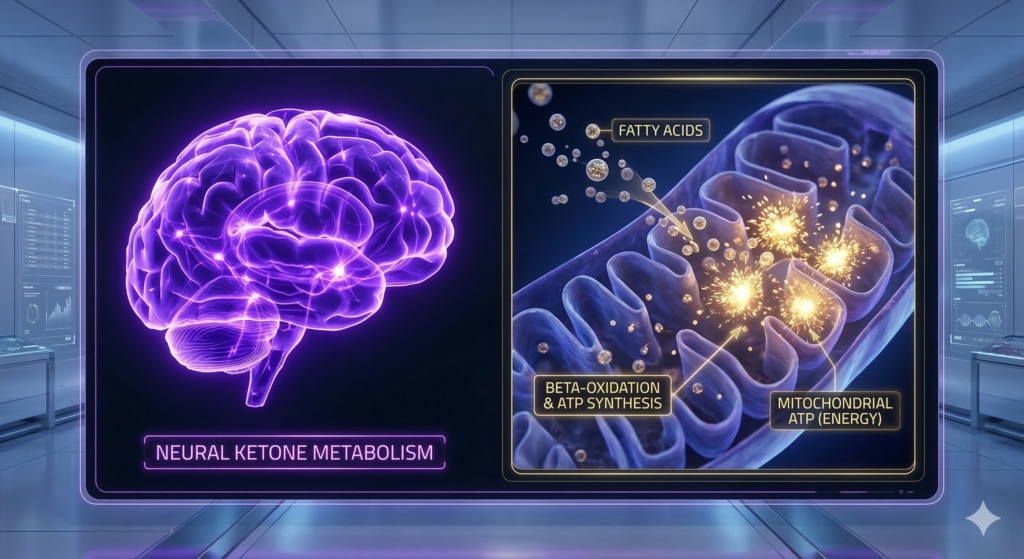
Most people are locked into a “Sugar-Burner” metabolism. They rely on frequent carbohydrate intake to keep their brain functioning. When blood glucose dips, they experience the dreaded “brain fog.” For the Hacked Human, the goal is Keto-Adaptation: teaching your mitochondria to efficiently oxidize fat and ketones for energy.
Phase 1: The Transition (The “Keto Flu”)
Keto-adaptation is not the same as being in ketosis. Ketosis is the presence of ketones; adaptation is the efficient use of them.
The Biological Mechanism: As you restrict carbohydrates, your insulin levels drop, allowing your liver to convert fatty acids into Beta-Hydroxybutyrate (BHB). Initially, your brain might struggle because it has “forgotten” how to use ketones efficiently. This transition period—often called the Keto Flu—is actually a result of sodium and electrolyte depletion as the body sheds excess water.
- The Hack: Increase sea salt and magnesium intake during the first 14 days to bypass the transition fatigue.
Phase 2: Why Ketones are “Super-Fuel” for the Brain
The brain is only 2% of your body weight but consumes 20% of your energy. Ketones are a much cleaner burning fuel than glucose.
The Biological Mechanism: When the brain burns glucose, it creates significant Reactive Oxygen Species (ROS)—essentially cellular exhaust. BHB ketones produce significantly less oxidative stress. Furthermore, ketones act as a signaling molecule, increasing the production of BDNF (Brain-Derived Neurotrophic Factor), which is like “Miracle-Gro” for your neurons.
Phase 3: Measuring the Shift
We don’t guess; we quantify. To know if you are keto-adapted, you need to track your GKI (Glucose Ketone Index).
- Nutritional Ketosis: 0.5 mmol/L – 3.0 mmol/L of blood BHB.
- The Tools: Use a blood ketone meter (like Keto-Mojo) rather than breath or urine strips for clinical-grade accuracy.
Phase 4: Long-Term Metabolic Flexibility
The ultimate goal isn’t necessarily to stay in keto forever, but to build the Metabolic Machinery that allows you to switch back and forth. This is the definition of a resilient human system.